

Aunque JUnit 4 ya tiene unos añitos siempre se me olvidan las anotaciones que soporta.
La forma más fácil de recordarlas es ver un ejemplo con las principales…ahí va:
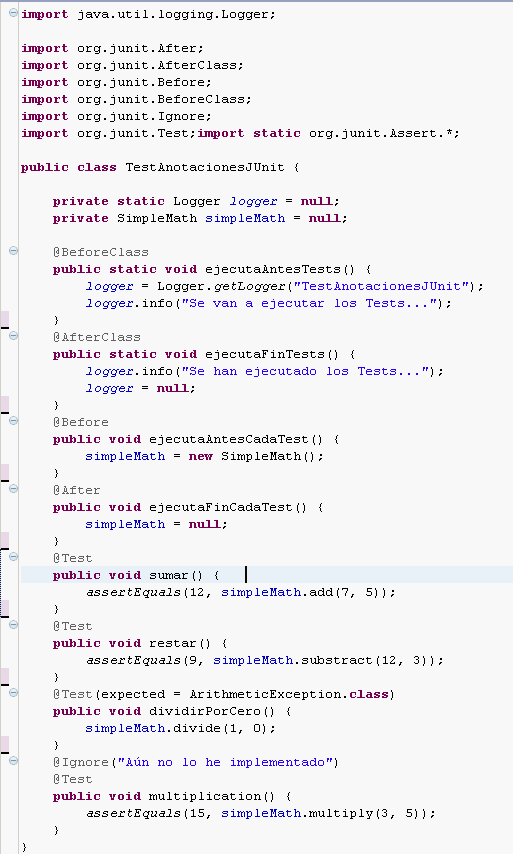
Y el código:
| import java.util.logging.Logger;
import org.junit.After; import org.junit.AfterClass; import org.junit.Before; import org.junit.BeforeClass; import org.junit.Ignore; import org.junit.Test;import static org.junit.Assert.*; public class TestAnotacionesJUnit { private static Logger logger = null; private SimpleMath simpleMath = null; @BeforeClass public static void ejecutaAntesTests() { logger = Logger.getLogger(«TestAnotacionesJUnit»); logger.info(«Se van a ejecutar los Tests…»); } @AfterClass public static void ejecutaFinTests() { logger.info(«Se han ejecutado los Tests…»); logger = null; } @Before public void ejecutaAntesCadaTest() { simpleMath = new SimpleMath(); } @After public void ejecutaFinCadaTest() { simpleMath = null; } @Test public void sumar() { assertEquals(12, simpleMath.add(7, 5)); } @Test public void restar() { assertEquals(9, simpleMath.substract(12, 3)); } @Test(expected = ArithmeticException.class) public void dividirPorCero() { simpleMath.divide(1, 0); } @Ignore(«Aún no lo he implementado») @Test public void multiplication() { assertEquals(15, simpleMath.multiply(3, 5)); } } |
Podéis descargar el JAR de la última versión estable de JUnit (la 4.8.2) de aquí: https://github.com/downloads/KentBeck/junit/junit-4.8.2.jar
El Getting Started aquí.
 Un poco de Java
Deja un comentario